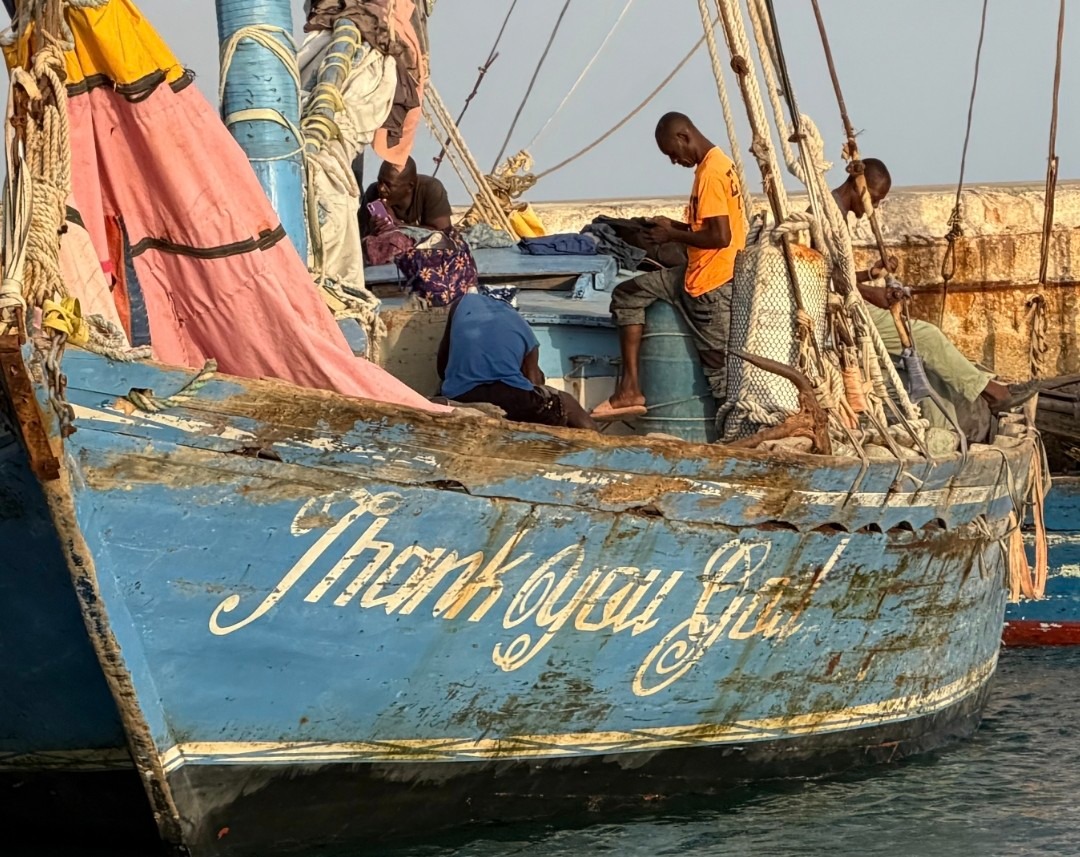
“Thank You God”

On Day 4 of a 2000 mile, 29 day sailboat delivery from San Juan to Kemah, TX we stopped to fuel at the southernmost Bahama Island. Great Inagua is not a swaying palm tree tourist oasis like its neighbor, the Turks and Caicos. It does not fringe a tropical lagoon. It is low, scrub covered and dry. Its 900 inhabitants are subsistence fishermen and the lucky ones work for the Morton Salt Company where sluiceways are opened to the sea and the inrushing saltwater then lays in shallow natural pans and evaporates under the relentless tropic sun. This leaves behind what will become the contents of the quaint blue cylinders of Morton’s Salt you buy at your corner grocery store.
200 years ago Great Inagua and other tropical islands were often the first destination for newly built sailing ships to take on a cargo of salt for ‘pickling’ the ship’s interior hold to preserve the new wooden hull for longer life.
As we approached the island, we picked up a distinctive vessel off our stern. It carried a multi-colored jib and a large oddly shaped mainsail. It had departed Cap Haitian on the north shore of Haiti 18 hours earlier in the middle of the night to make the 110 mile passage north across the Old Bahama Channel. Heavily built of wood with spars -mast and boom- made of tree trunks, it was 40 feet long with 8 men on board. It was without an engine, navigational instruments, plumbing or electricity. To be seen at night it carried one small masthead light. It was a Haitian freighter or cargo boat transporting goods to and from the island nation. It followed us in to Great Inagua.
Sue and I had first encountered these sailors and their vessels years earlier and 200 miles to the north when we were anchored in the busy roadstead between Nassau and Paradise Island. After a much longer voyage the Haitians would sail in through the glitz and glamour of this tourist mecca, past the docked cruise ships and anchor off the city dump. They would come ashore to scavenge the discardings from the nearby first world neighborhoods and return to their boats with refrigerators, washers, AC units, bureaus , sinks, pumps, tires. All items would go below deck and the deck was now available for two stacks of 4-5 used mattresses piled one on another that now served as new sleeping spots for the crew who had lost their below deck accommodations.

The Haitian vessels did not come north to Nassau empty-handed however. They carried carved totems, lizards, birds. fish, turtles and other hard wood creations produced by their countrymen which they sold to vendors at the waterfront’s Straw Market who would in turn sell to the cruise ship passengers. They also carried, buried in the ship’s bilge, marijuana. This was easy to recognise because Haitian weed was invariably impregnated by fine white tendrils of Mycelia, the thread-like filaments of fungus. This would grow in the bricks of dope when the weed got wet hidden under the floorboards. This did not much seem to diminish the quality of the product.
This waterborne trade between Haiti and Nassau continued for some time and the sight of these primitive worn sailing vessels with their gaudily patched sails and tired paint was something to behold as they made their way through the magnificent yachts of the vacationing elite.

Yet all this came to a halt when the Bahamian government started receiving complaints from cruise ship passengers nine stories up while enjoying morning coffee from their outside balconies. It seems that while gazing out over the harbor, the guests saw to their horror the Haitians emptying their buckets of waste overboard next door.
So now the Haitians are restricted to solely visiting the southernmost Bahama island. Freighters from Nassau twice-monthly deliver semi-trailers with discarded pallets which the sailors from Cap Haitian pull apart for the valuable wood their country sorely needs.
Just as the notorious ‘Pirate Republic’ of Nassau was doomed in 1718 with the arrival of the new governor, Woods Rogers, a privateer and slaver himself as well as the rescuer of Alexander Selkirk, the inspiration for “Robinson Crusoe”, so a fascinating more recent piece of local color is now lost to Nassau with the ousting of the Haitians.
So ironically while the impoverished Haitians still sail north with ‘Thank You God’ inscribed on their boat’s side, Nassau’s more fortunate visitors now peruse duty-free shops, eat at fine dining establishments, play in the casino and amble along glorious beaches with prescription bottles of anti-depressants ever present in their pockets.