Sail to Abaco
Florida Keys

We float aboard our home, 48' sailing catamaran 'Surprise', eight nautical miles at 77 degrees from the headquarters of John Pennekamp Coal Reef State Park in Key Largo, Florida. We are anchored over the reef, the coral necklace that girds the Florida Keys as it does tropic lands throughout the world. We are six miles east of land. We are in 9 feet of crystalline water with late afternoon summer skies threatening. This is of minor concern.
At this spot exactly 300 years ago today a hurricane closed on the Spanish Treasure Fleet of 1715. The fleet of 11 treasure-laden galleons was returning to Spain from the New World. They had rendezvoused in Havana, Cuba from points south and west in Columbia, Panama and Mexico to prepare for the Atlantic Ocean crossing. Their course lay from Havana up the east coast of Florida to present day Cape Canaveral then east across the sea to Bermuda, the Azores and into Cadiz, Spain.
But the heavy vessels had a challenge at the start. They must navigate the Florida Straits and ride the Gulf Stream. The great ocean river that is the Gulf Stream makes up in the clockwise flow of the northern hemisphere to produce a whipsaw as it comes north through the Yucatan Strait, merry-go-rounds the Gulf of Mexico then loops around the large peninsula of Florida where it turns north and runs hard and narrow between Florida and the Bahamas.
Unfortunately, the Treasure Fleet had dawdled in Havana. The ships left July 24th - on that fateful year, too late into the hurricane season. Five days out of Havana there's now strong current, wind and wave, shredded rigging, breaking ships, groundings, panic, death and a huge lode of gold, silver and gemstones, tobacco, exotic spices, indigo and fine porcelain scattered across the shallow ocean floor. And for the few survivors, a desolate beach stretching 180 miles with the lonely outpost of St. Augustine three weeks north if the desperate march is not cut short by Ais Indians, thirst, hunger and exposure.

Trusting we'll have an easier voyage than this, we pull the hook on Surprise before daybreak at 0430 hours and head northeast out into the Stream. Our intended destination is just north of Grand Bahama Island's westernmost point, on the Stream's eastern edge. Because it's summer we're likely to avoid the 'galloping elephants,' huge waves produced by a strong north wind countering the north moving current. If not these or a persistent east headwind, the Stream should let us cross sailing 110 nautical miles then onto the Little Bahama Bank before nightfall. We must calculate our speed with the Stream's current, two to three knots at its center, and set a course 10-20 degrees south of our intended landfall {reeffall) to make good our destination.
With a rolling three to four foot sea the crossing proves 'uneventful,' a most welcome word in the lexicon of bluewater sailors. The water color changes from cobalt blue to aquamarine, the depth finder springs to life, the sea state quiets and we have arrived on the western edge of the Bank at 1820 hours in good daylight.

The Little Bahama Bank, a huge shallow sand and limestone seamount rising 1.5 miles from the ocean floor, is bordered by Grand Bahama Island to the south, Little and Great Abaco Islands to the east. The Bahama Banks, both Little and its Great brother to the south, were built of calcium carbonate over a period of 200 million years. The islands of the Bahamas were formed as limestone reefs when the sea level was up to 100' higher than it is today. The planet then cooled, polar ice caps formed, the sea retreated and the Bahama islands emerged.
We start eastward across the Bank but it is getting dark. Sue, my wife and first mate, Surprise's chef when running charters, and the Admiral (I'm only the Captain) asks, "When will we stop?" I answer, "Whenever you'd like." Amazingly, we're out of sight of land and ready to drop the hook in 14 feet of water. We are alone. We anchor for the night. I dive on the hook to check that it's securely set. I sleep better that way, though tonight we'd have miles to drag before encountering a thing.
Without a horizon between earth and sky, everything in this environment is wide and distant and hued in blue. Until it's not. Convective currents of wind build through the day over the warm shallow water. Then thunderstorms rear up in the afternoon. Puffy cumulus clouds change to cumulonimbus then close to the horizon with rain and advance. Hopefully not to you. Nonetheless, decisions have to be made. Do we reef or lower sails, put on raingear, dog hatches, batten gear? Now study the sky. Where has this cell come from? How big is it? Where does it track? Will it hit us? Does it carry thunder and lightning?
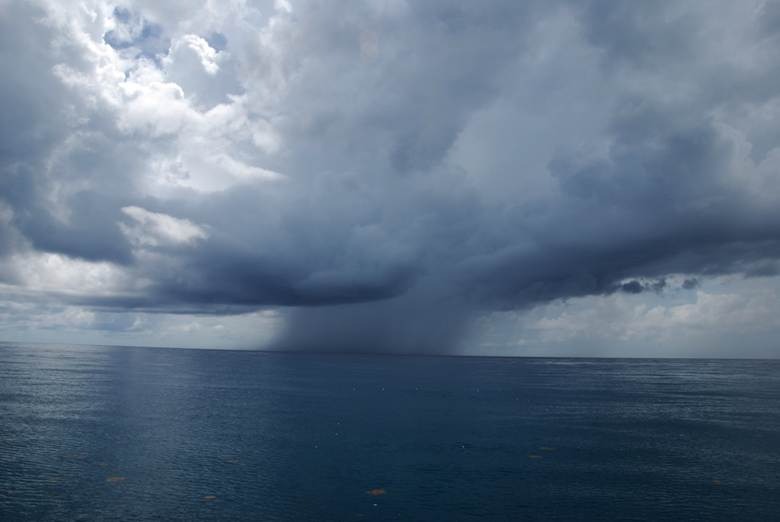
The sheets of rain turn the sky grey. The rain arrives. We get slammed with sustained winds of 35 knots, gusts to 50. We're in a White Squall. We can't see sea from sky. That interface has rain hitting water so hard, shattering and ricocheting up that there appears just a four-foot high white fuzz blending to dark grey as your eye moves up. If we're filming the movie of the same name from 1996, it's time to turn off the jet engines blowing hard spume over the wave tank and get a rescue diver in to save Jeff Bridges before he drowns - for real. The squall is over in 20 minutes and moves on.
East across Little Bahama Bank we sail and at the end of the next day we're at Great Sale Cay for the night, a handy uninhabited Cay offering some protection. Great Sale's low limestone scrub-covered shores are undercut. The soft rock has been dissolved by rainfall, weathered by wind. The underwater periphery with its holes, shallow caves and shelves harbors a rich assortment of creatures. The Spanish, on discovering "Habacoa", were not duly impressed and moved south, but they spent no time underwater.
We don mask, fins and snorkel and slip into the water. We quickly find a small green turtle resting under a shelf and bring her back to Surprise. We hope this youngster may have been born on Florida's east coast where much effort is now underway to protect sea turtle nests and hatchlings. We enjoy our turtle visit perhaps more than she does and then we enjoy turtle steaks.... just kidding. "Turtling" is now illegal in the Bahamas, but unfortunately a meal can still be found with little effort. Back to the shelf our visitor goes and all returns to serenity on board.
On east we travel from Great Sale, but on leaving we have to decide do we risk a southern departure through the reef or continue two miles further in the wrong direction to gain deeper water? 'Reading the water' is an acquired skill. One needs to know what color means what and how deep. Surprise draws 4.5 feet. Poor judgment can be disastrous. Sue goes to the bow and, with hand signals sent back to me at the helm, directs Surprise through the shallow coral heads, beautiful but deadly. We're unscathed and have saved two hours. We turn back east and
continue to the Sea of Abaco coming in at uninhabited Allen-Pensacola Cay.

We found this Cay ('little island' and pronounced "key") on our first cruise to Abaco in 1998. We were sailing our 28' Dragonfly trimaran. "What?? You're going to take that small boat with no freeboard across the Stream?" Allen-Pensacola has a south end 'hurricane hole' that is fanciful. You need extremely shallow draft (under 2 feet) and, when you have navigated 100 yards of narrow channel, the circular one acre hole opens up to a red-mangrove lined shore with a small perfect beach. A short walk from the beach leads to the cay's east shore, an idyllic palm-fringed crescent bay, powder white sand, not a footprint. Paradise! What fun to linger and share this magical spot. The stuff of calendars and travel agent brochures. However, the first time we visited Allen-Pensacola was on the heels of a shark scare. Sue and I, with snorkel gear on, had dropped backwards off the dingy. A nearby shark, hearing the splash, had come to investigate, face-to-face. We drop into the water a bit quieter now.
From Allen-Pensacola we turned further south and entered the Sea of Abaco. Now as you glide by the islands and survey the surrounding real estate, you're talking Bahama dreams come true for those proved highly successful and the glorious 1%. The island nation now appeals worldwide as a tropical destination and has enriched itself greatly as the close neighbor and beneficiary of Big Brother to the west. In addition to the native white and black Bahamians, the country is primarily inhabited full or part-time by Brits, Canadians and Americans. This all began when, following our Revolutionary War, many British loyalists fleeing the colonies ended up in eastern Canada or the Bahamas, both members of the British Commonwealth. More recently enterprising Americans showed up at the turn of the previous century and again in the 1940's to harvest the virgin Caribbean pine forest of Grand Bahama and Great Abaco Island. In Abaco life was changing. Now there were roads, electricity and an ice plant. For the first time, subsistence living for the lucky few was replaced by a weekly paycheck.
Piracy, wrecking, fishing, boatbuilding, pineapples, sisal, sponging, and lumbering had all been attempted. Southerners from the States had even showed up with their slaves following the Civil War thinking to recreate their plantation life. But to the Bahamas' great good fortune, following World War II, visiting yachtsmen and foreign visitors were discovering the Bahamas. No longer was the "Out Island Doctor," Evans Cottman, sailing his hand-built wooden sloop to visit your isolated and remote island settlement once a year to address your ailments.
We sailed Surprise south down the Sea of Abaco past Powell Cay, Green Turtle Cay, around "The Whale", past Great Guana and Man-o-War Cays. We stopped at favorite lobster holes to gather 'bugs' and pick up conch. We fell in with old cruising buddies and caught up on recent voyages. We spied the Hopetown lighthouse off our port beam, the last manual lighthouse in the world. The British had started building this lighthouse in 1863, but it was not completed for over a year. Seems each day when the builders came to work, the previous day's accomplishments lay dismantled and scattered on the ground. The locals had no interest in easier navigation for offshore ships when there was wrecking to be done. We sailed across the Sea to Marsh Harbour, the largest settlement in Abaco - with one stoplight, an appropriately fitting re-entry after a week at sea and now time to kick back.

But not so across the pond and 300 years ago, for In 1715 King Philip V of Spain was on the throne once again having abdicated in favor of his son, Luis, who had died unexpectedly of smallpox. The King now had two pressing problems. He was without consort, his first wife having died in 1714 at age 26, and Philip was anxious for more children. Furthermore, the War of the Spanish Succession had just ended leaving Spain in serious debt. To Philip's good fortune a second wife was soon found in Elisabeth of Parma. But contrary to custom, it was Elisabeth who demanded a dowry. And, as she made clear, consummation of the marriage would not be forthcoming without one. The arrival of the New World Treasure Fleet that year would solve both problems. Unfortunately, as we have seen, the fleet never made it. Thus, aided by two major finds in 2013 and 2014, it is the treasure hunters and beach-going tourists on Florida's 'Treasure Coast' who have been wearing the 'Queen's Jewels' ever since.
P.S. The good Queen did relent and produced six offspring for her King.