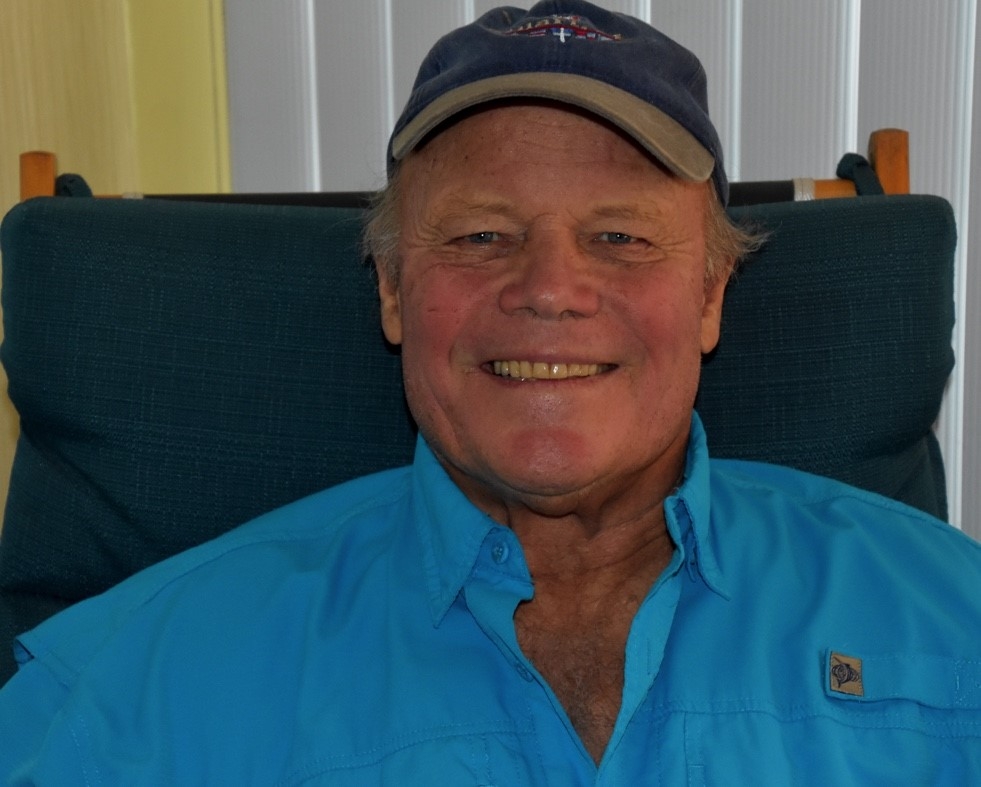
Introduction from Grandpa
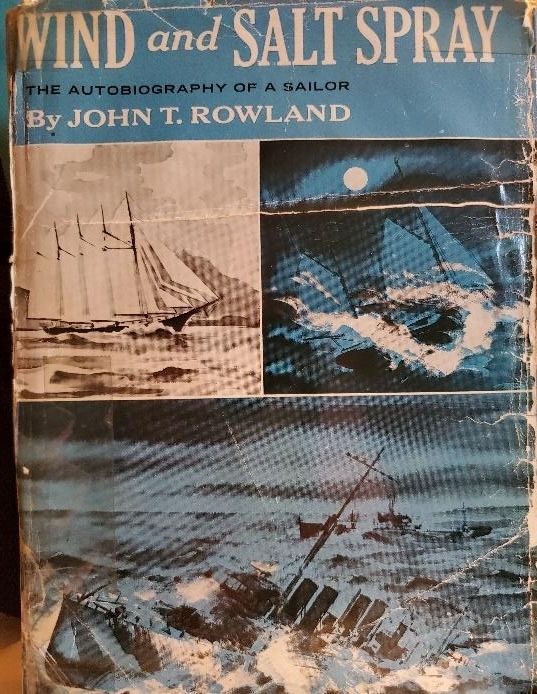
“Wind and Salt Spray” Chapter 1, 1965
John T. “Pete” Rowland (1888-1980) was born during a storm on March 12th in Greenwich, CT.
The event lasted three days and became known as “The Great Blizzard of 1888.” Grandpa was a
tad early so his parents incubated him in the oven. Fortunately they left the door cracked…
Herein, an excerpt from his second book, with permission.
Adventure
This is a book about adventures.
Adventure has been described as “expectation of the unexpected,” and the more one thinks about it the better that definition sounds. It is, of course, wholly subjective, depicting a state of mind rather than an event; but what else is adventure except the way one feels? A boy’s idea of adventure will differ quite radically from his sister’s, and their father will have a different notion still; but in all three the quickened pulse and tingling nerves will have been caused by anticipation of something unusual. That is what it takes.
This may explain the ancient lure of the sea. A sailing ship does not have to be fighting pirates in order to make her voyage exciting: it is an adventure just to go to sea, because one never knows what is coming. I have sailed to Labrador with calm seas and gentle breezes, only to come back and encounter a hurricane on Long Island Sound. As a boy particularly, it seemed to me that adventure lay just over the horizon; and quite frequently that was the case. One cruise I remember had all the basic elements of human adventure compressed into a single week. Only the gift of youth brought us through unscathed, yet at the time we were neither startled nor unduly impressed; we would have felt cheated if nothing unusual had occurred.
This high incidence of the unexpected was, I think, partly due to the absence of gadgets. We had no engine, no radio, no airplanes hovering overhead like frenetic nursemaids, and – best of all – no Coast Guard, as we know it now. The Coast Guard of those days was a shore-based beach patrol with a few lifesaving stations here and there in areas like Cape Cod and Cape Fear where wrecks most frequently occurred. Elsewhere the roving yachtsman was on his own.
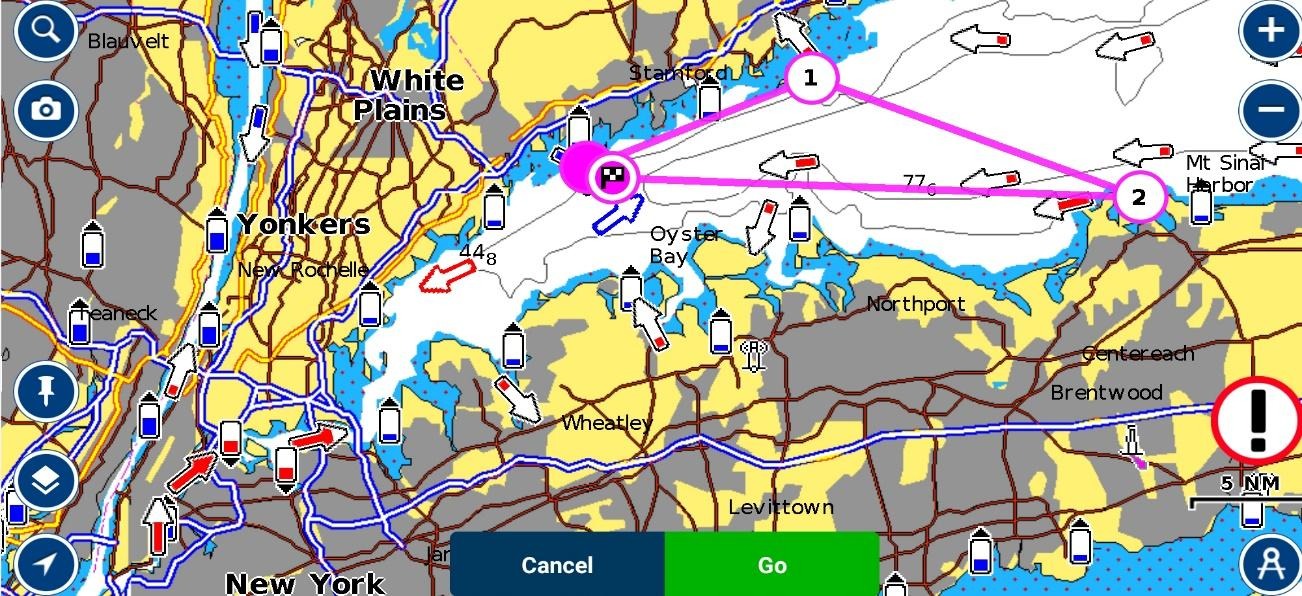
Summer Cruise, 1904. Greenwich (on left), Norwalk #1, Port Jefferson #2, NYC lower left
One beautiful day in late August my Pal Arty and I shoved off on a last cruise before going back to school. I was sixteen and he a year or two older. The boat was an old centerboard sloop, 25 feet long, that had been handed down from one brother to another in my family until she came to me. A lot of craft for two boys to handle, she was nevertheless so sturdy and we so used to her that our only thought at the moment was to make the most of a fair wind. Our home port was Greenwich, near the western end of Long Island Sound, and we intended to follow the Connecticut shore easterly as far as we could get before dark.
Here the unexpected intervened. When we were off the Norwalk Islands a couple of hours later, we passed a dirty , black sloop with three men on board, and she immediately came about and gave chase. The Sound was not so crowded sixty years ago; except for a couple of coasting schooners well offshore there was not another vessel in sight, and the islands under our lee were uninhabited.
We changed course to see what would happen, and the black schooner followed. It seemed strange. We had passed close enough so that if information was what they wanted, they could have shouted over. But these men seemed to know what they were about, and they were flying no yacht club burgee or private signal. We noticed that the black paint job appeared to have been done hastily, and the name on the stern was painted out.
A few days prior to this event the newspaper had carried stories about a gang of burglars who were believed to have used a boat of some sort to make their getaways. Several homes along the Connecticut shore had been pillaged and no trace found of the marauders. It was conjectured that a sloop yacht that had disappeared mysteriously from her moorings near Boston might be their vessel. If that were true the description of the Boston sloop fitted this one, all but the color. Perhaps now the robbers wanted to elude pursuit by changing boats.
That would provide a motive, and it looked bad for us. If they took our boat, they were not likely to leave us to give them away.
The wind blew fresh and fair from the southwest, right over our starboard quarter. This made a broad reach, which was our old boats best point of sailing; but it soon became clear that we were no match for the black sloop. She had lost ground in tacking, but slowly and surely she was catching up.
There is an old saying that “a stern chase is a long chase.” The faster ship looses much of her advantage when running before the wind. With this in mind, we changed course again and brought the wind dead aft. The black sloop followed, perhaps five hundred yards astern, but now we seemed to be almost holding our own.
On this new course we were heading directly for Ram Island, one of the smaller in the Norwalk group, not more than half a mile away. The harbor lay on the other side; on this side it was foul water and the narrow channel between Ram and the next island was strewn with rocks and reefs. It appeared, therefore, that we could not go far on this heading; but, on the other hand,
I dared not alter course.
We had on board a fowling piece and a .45-caliber revolver that my oldest brother had carried in the Philippines during the Spanish American War.
“Arty,” I said, “I am going to run her ashore. We’ll take cover behind boulders and trees. They will have to anchor off, and if they see we mean business they’ll never dare row ashore in a skiff.”
“Sound idea,” Arty answered, “provided you don’t hit a rock first. I’ll go forward and watch out.”
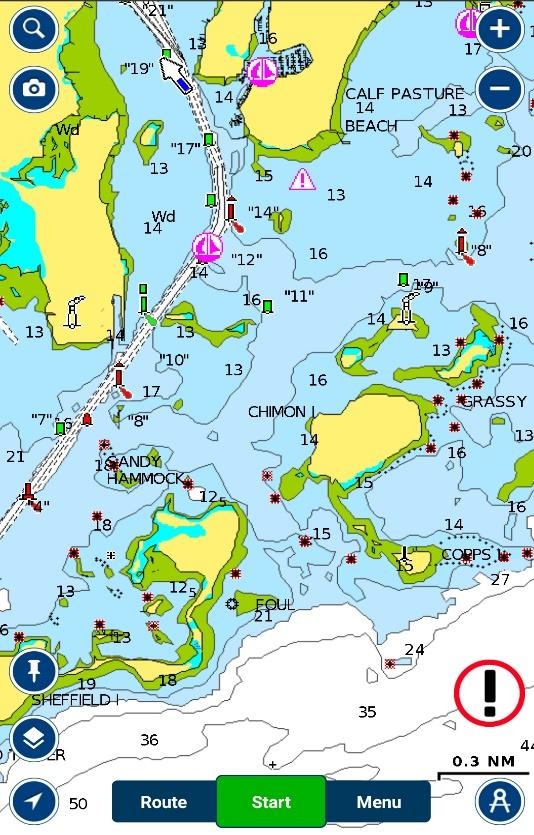
To make matters worse, the tide happened to be dead low. As we approached the island I could see rocks sticking up all over. The greater number lay directly off the beach. In avoiding them I was forced further and further east, and before I knew it found myself in the shallow channel between Ram Island and its neighbor, Chimon.
We could see the bottom under us, but with her centerboard hauled up the old sloop stayed afloat. She ran through between the islands without touching.
Our pursuer dared not chance it. She was a keel sloop and her draft would have run her hard aground. At the last moment she rounded into the wind and tacked, then stood out towards deep water In the Sound. Looking back, we could see her black hull diminishing in the distance. We kept on into Norwalk Harbor, and anchored for the night.
The channel between Ram and Chimon, Norwalk at top
Were our fears justified and our escape as narrow as it seemed? We never knew. Actually, I think, Arty and I felt there must have been some other explanation for the black sloop’s strange behavior, though we could not imagine any that would fit. But, pirate or not, what really tickled us was the way we gave her the slip. It savored of exploits in the War of 1812.
Next day we sailed across the Sound to Port Jefferson, then a peaceful Long Island village. We had scarcely got the hook down and sail furled, with an awning rigged over the cockpit for our comfort when a skiff with two girls in it came rowing slowly through the fleet of anchored yachts. They seemed much taken with our old craft and passed so close it would have been discourteous to ignore them. Arty greeted them and invited them aboard. This, after some hesitation and considerable conversation, they consented to do.
They were nice girls, about our own age, friendly and unsophisticated, but not especially pretty. Marie, the elder of the two, lived in Port Jefferson and the other was her guest. Their manners and conduct were impeccable; one might have supposed they were being entertained aboard the President’s yacht. We served them warm ginger ale and ship’s biscuits (the best we had, since there was no place to carry ice) which they accepted graciously and pretended to enjoy. Before they left I mustered courage to invite them for a sail next day.
Again the unexpected had intervened; instead of one night in Port Jeff, we stayed four days.
Marie especially love sailing. At the helm in a fresh breeze, with her blue eyes sparkling and the hair blowing about her face, she was really pretty. Once when she looked like that I stole a kiss, and she didn’t seriously object; but our relationship remained strictly that of friends, as it would have been with two such girls at home. For that reason, perhaps, I was unprepared for the bombshell that burst next day.
We had warned the girls that we were leaving, and they expressed regret. There seemed little doubt that our sailing parties had saved a dull season. What I did not realize was the extent to which they had awakened new ideas.
I did notice that Marie seemed to be laboring under some suppressed excitement when the two came aboard next morning. She said little and had a faraway look. This kept up all through our sail; she did not even ask to steer.
On the way back up the harbor I started saying how sorry we were to have to leave.
“We’re going with you!” Marie burst out, “It’s all decided. Nobody has got to say goodbye!”
Arty and I exchanged quick glances – mine of dismay, his, I thought, rather more of a speculative nature. I was struck dumb, and Marie apparently took silence for consent.
The plan it appeared, had been concocted overnight by the two girls. Permission had been gained for Marie to pay a return visit to her friend in Brooklyn. They would take the afternoon train but get off in Huntington and come back, arriving in Port Jeff at half past ten that night.
“Just meet us at the old coal pier with your dingy,” said Marie. “That’s all you’ve got to do. I’ll bring my ukulele, and, just think, it will be full moon! We’ll sail off into the night!”
They departed happily and rowed ashore after giving us each a shy and rather perfunctory kiss.
This was not to be a protracted cruise. We were simply to sail them up the Sound and put them ashore next afternoon at some point from which they could reach their destination before night. Marie said her family would not be expecting word before that.
“So you see, it’s perfectly safe!”
I was less sure about that, but the girls, I felt certain, wanted only to go sailing – at night, under a full moon. Novelty, romance, and a moonlit sea – in a word, adventure!
“But, good Lord, Arty,” I exclaimed. “We don’t even have plumbing….!”
He nodded and glanced at the departing skiff. Then out of the wisdom of his eighteen years he said slowly, thoughtfully, “You just might be mistaken. Well, if you don’t like it, there’s only one sure out.” And he jerked his head towards the harbor mouth.
Fifteen minutes later our old sloop slid through with the ebb tide and regained the safety of the open Sound. I felt a heel.
The breeze died before we had sailed ten miles. The sun descended blood red into a bank of murk. Distant rumblings of thunder smote our ears.
“We’re going to catch it,” said Arty, “and it’s going to be a beaut.”
He was right. This was no ordinary thunder squall but one of those ring-tailed snorters that used to sweep across the Sound once or twice a summer with close to hurricane force. We had plenty of warning; with darkness the lightning became incessant over the Connecticut shore. We lowered our sails and furled them tight, lashed the dingy on deck and secured the helm. Then we went below and cooked supper because we knew there would be no eating or sleeping once the storm hit.
Our old sloop was stout; it could not hurt her. But while it lasted it was an awesome sight.
By nine o’clock it had blown over, leaving a turmoil of sea and a moderate northwest breeze. We made sail again and got back on our course for Greenwich. The wind gradually increased and drew ahead. At midnight we had to double-reef the mainsail. It blew hard out of a steely, clear sky so that we spent the rest of the night thrashing to windward and finally made Greenwich harbor just as the sun was coming up.
“Some moonlight sail!” said Arty, peeling off his oilskins after we had picked up the mooring and made everything secure. “Just shows, you never know what’s coming up!”
It was a week since we set out, and in that short time we had sampled the three basic ingredients of earthly adventure – violence of man, violence of nature, and the wiles of women. Of the three, our greatest peril was probably the last. Still, if anyone had inquired whether we had been in danger, we would have scoffed at the idea. Some excitement, yes, and the necessity of coping with the unforeseen, but that was no more than pleasurable adventure. We had learned early that age-old maxim of the sea: Look out for yourself, Jack; nobody is going to do it for you.”
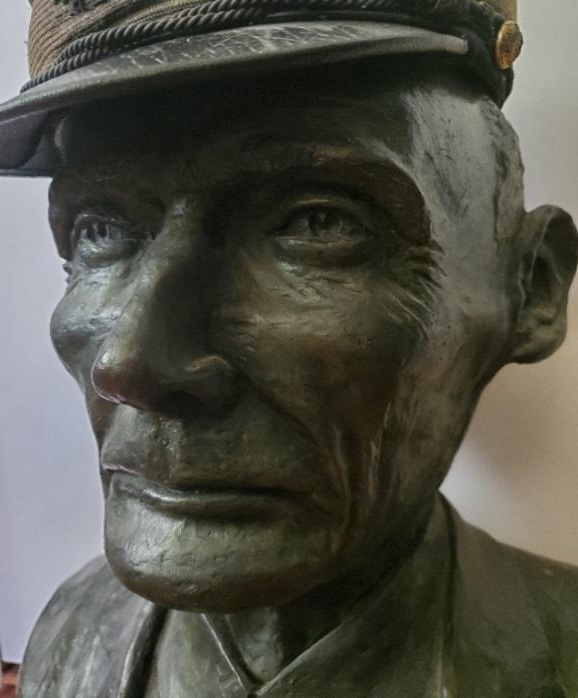
Looking a bit like an Easter Island Moai, Grandpa “Pete” in later years. His bust resided for some time at the Farnsworth Art Museum in Rockland, Maine. He spent his last years on a farm just down the road on the Damariscotta River.
His bust now joins me in my Office and I write at his desk.